
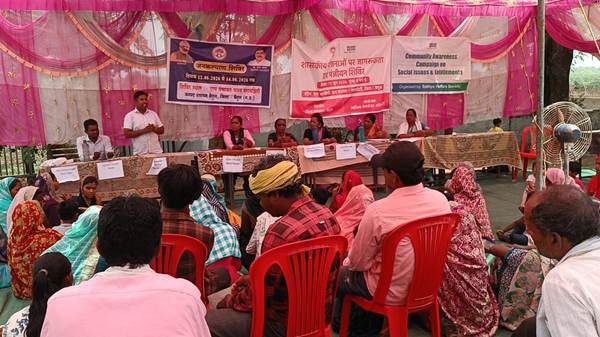
A single-day awareness camp in Maramjhiri village of Betul Block turned weeks of door-to-door groundwork into 122 welfare registrations — and a renewed community conversation about forest rights.
On a June morning in Maramjhiri, a quiet village courtyard became a meeting point between government entitlements and the people they are meant to serve.
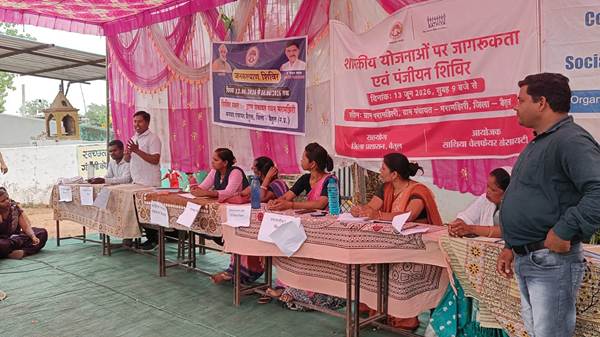
Sathiya Welfare Society organized a Community Awareness Campaign on Social Issues and Entitlements on 13th June 2026 at Maramjhiri, Gram Panchayat Maramjhiri, in Betul Block. The camp is part of SWS’s ongoing programme to strengthen access to social security schemes and community participation in local governance across 10 Gram Panchayats of Betul Block.
Over the course of a single day, the camp translated government policy into plain conversation — on welfare schemes, legal entitlements, women and child protection, and the practical, often confusing process of applying for them. Villagers did not just listen. Many walked away with new registrations in hand.
The Groundwork: Weeks Before the Camp Began
A camp succeeds or fails long before it opens. In the days leading up to 13th June, SWS team members went door to door across Maramjhiri, explaining what the camp would offer and which documents — an Aadhaar Card, a Samagra ID — households would need to bring.
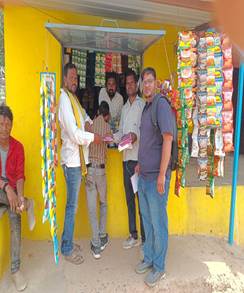
The outreach did not stop at doorsteps. Informational pamphlets were distributed across the village, public announcements (munadi) were made with Panchayat support to reach households that outreach visits alone might miss, and members of the Jagruk Nagrik Manch — a local citizens’ awareness group — joined the mobilization effort. Close coordination with Panchayat representatives, ASHA workers, and Anganwadi workers helped the team identify eligible beneficiaries well before camp day.
Villagers were also sensitised in advance about the Ayushman Bharat Scheme and other welfare initiatives — groundwork that built the trust needed to bring people out on the day itself.
By the Numbers
The camp’s facilitation desk recorded 122 registrations in a single day — a direct measure of how effectively the groundwork converted interest into enrolment. They walked in with questions about entitlements — and walked out registered.
| 122 Total registrations | 62 Sambal Yojana | 47 Ayushman Card | 13 e-KYC & others |
Forest Rights, Explained
Among the day’s sessions, the one led by resource person Mr. Shyam Belvanshi drew close attention. He walked participants through the Forest Rights Act (FRA) — covering Individual Forest Rights, Community Forest Rights, and Community Forest Resource Rights — and clarified the distinction between Revenue Villages and Forest Villages.
He also introduced participants to the MP FRA Portal and the Van Mitra Portal, and explained how a Forest Rights Committee (FRC) is formed. Under the rules he outlined, every FRC must have 15 members, with at least five women among them, and must be constituted through a Special Gram Sabha.
| 15 members, at least five of them women — that is the law behind every Forest Rights Committee. |
It was a reminder that awareness work in Maramjhiri reaches beyond welfare registrations alone, into the structures of participation that determine who gets a seat at the table.
A Village, and Its Institutions, in the Same Room
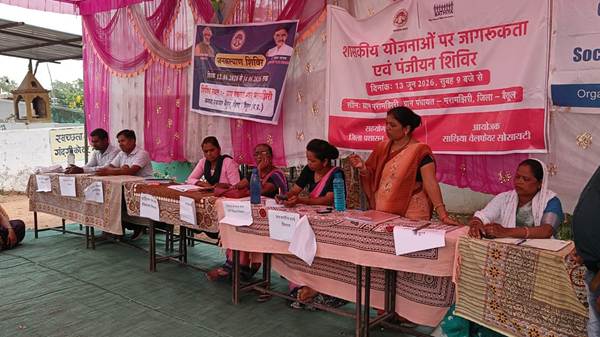
The camp drew participation not just from villagers but from the institutions meant to serve them. Gram Panchayat Secretary Ms. Maya Patankar and Sarpanch Ms. Sanoti Dhurve attended, alongside representatives of the Women and Child Development Department — Anganwadi Workers Ms. Kiran Chaudhary, Ms. Anjali Khatarkar, and Ms. Sangeeta Kare, Anganwadi Helper Ms. Malti Kumbhare, and ANM Ms. Sharma.
From Sathiya Welfare Society, Project Lead Mr. Avinash Trivedi, MIS Coordinator Mr. Jitendra Prajapati, and Community Resource Person Mr. Santlal Dhurve coordinated the day’s implementation — guiding beneficiaries through registrations and documentation, and connecting them to the schemes they were eligible for.
What the Day Added Up To
- Increased community awareness of social security schemes and legal rights.
- Improved access to Ayushman Bharat and Sambal Yojana registrations.
- Greater awareness of child protection, safe migration, and women’s rights.
- Stronger community participation and trust in support systems.
- Closer coordination between villagers and local service providers.
Looking Ahead
Maramjhiri’s camp is one stop in a wider effort: SWS continues to run these campaigns across villages in Betul Block, working to close the distance between government entitlements that exist on paper and the households who are entitled to them. For a village that spent weeks preparing for a single day, the measure of success was simple — more people walking away registered, informed, and a little more connected to the systems built to support them.
Recent Comments