
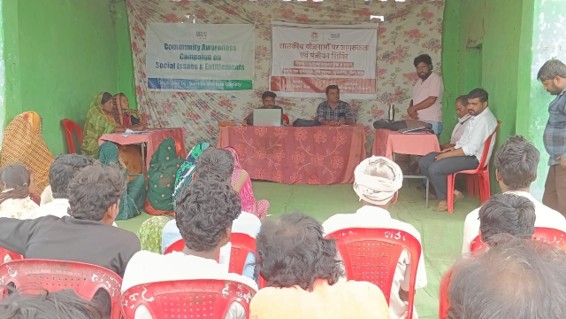
A community camp in Gram Panchayat Kumhartek connected villagers with social security schemes, legal awareness and the officials who can help them claim their entitlements.
On 13 July 2026, the village of Kumhartek in Betul Block, Madhya Pradesh, became a meeting point between rural families and the welfare systems meant to serve them. Sathiya Welfare Society organised a Community Awareness Campaign on Social Issues and Entitlements, bringing villagers, officials and local volunteers together in one place.
The camp formed part of the Society’s ongoing initiative to ensure access to social security schemes and to strengthen community participation in local governance across 10 Gram Panchayats of Betul Block. Its focus was practical: raising awareness of government welfare schemes, legal rights, and the protection of women and children, while offering direct, on-the-spot facilitation to eligible families. Awareness only becomes access when it reaches the doorstep, and the Kumhartek camp was built around that idea.
| Awareness only becomes access when it reaches the doorstep. |
Who Came, and What They Asked
The turnout reflected the camp’s wide appeal. Villagers, women, adolescents, children, social workers and local stakeholders all took part, engaging directly with resource persons on the questions that matter most in everyday life: pensions, Ayushman cards, labour registration, social security benefits, and the documents needed to claim them.
The Camp in Numbers
The camp drew a strong response in registrations and in the delivery of entitlements on the spot.
| 108 Participation | 69 Sambal Yojana registrations | 75 Ayushman Card registrations | |
| 9 Ayushman Cards generated on-site | 19 Sambal Cards generated on-site | ||
Before the Camp: Reaching Every Household
A good camp begins long before the first chair is set out. The Sathiya Welfare Society team followed a structured mobilisation plan to ensure strong turnout from across the Gram Panchayat, combining face-to-face outreach, trusted local partners and multiple communication channels.
Door-to-door conversations
Team members visited households across the Gram Panchayat to tell families about the camp. Residents were also guided on the documents to keep ready, such as the Aadhaar Card and Samagra ID, using simple and accessible language.
Building trust around Ayushman Bharat
Villagers were sensitised on the benefits of the Ayushman Bharat Scheme and other welfare initiatives through informative pamphlets, helping to build trust and encourage wider participation.
Working with local partners
2. Community discussion, supported by local frontline workers and representatives.
Close coordination with Kumhartek Panchayat representatives, ASHA workers and Anganwadi workers was central to the camp’s success. Their knowledge of the community supported the identification of eligible beneficiaries and the effective mobilisation of households.
Jagruk Nagrik Manch on board
Members of the Jagruk Nagrik Manch actively supported the mobilisation process and played a significant role in encouraging community participation.
Pamphlets and public announcements
Informational pamphlets reached the village so that every household knew the camp’s date, venue, services and required documents. With support from the Panchayat, public announcements (munadi) were also made throughout the village, reaching residents who could not be contacted directly.
On the Day: Rights, Schemes and Answers
Gram Sabha, Panchayati Raj and the law
Mr. Vinit Goswami of ASSS Organisation attended as Resource Person and led an awareness session on the Gram Sabha, the Three-Tier Panchayati Raj System, the Forest Rights Act (FRA) and the PESA Act. He explained why active community participation in local governance matters and outlined the rights and responsibilities citizens hold under these provisions.
He also walked villagers through major welfare schemes, including Ayushman Bharat, Sambal Yojana and Pradhan Mantri Awas Yojana, with particular emphasis on eligibility criteria, required documentation and the application process. The message to the audience was clear: keep documents updated and take part in Gram Sabha meetings regularly, which makes it easier to access government welfare programmes.
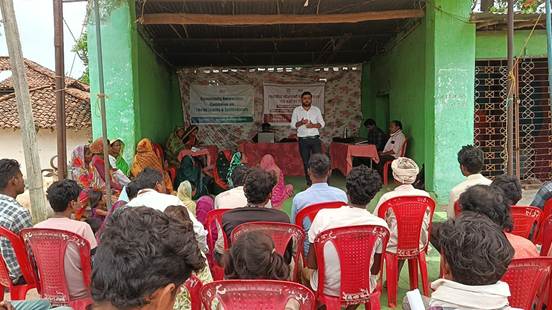
| Keep your documents updated. Take part in the Gram Sabha. |
Maternal health and the Matru Vandana Yojana
The Community Health Officer (CHO) from the Health Department explained why essential documents must be kept in order to access welfare schemes. The session also covered the Pradhan Mantri Matru Vandana Yojana, including its objectives, eligibility criteria, benefits and application process. Participants were encouraged to use maternal health services and the government support available to pregnant and lactating women.
Documents, water and the environment
Ramdas Gohe, Panchayat Secretary, stressed the importance of keeping the Aadhaar Card, Samagra ID, bank passbook and other identity documents ready so that schemes can be accessed without difficulty. He also raised awareness of the Jal Ganga Samvardhan Abhiyan, highlighting water conservation, rainwater harvesting, protection of water sources and plantation for environmental sustainability, and encouraged villagers to take part in these efforts.
Throughout the camp, villagers spoke with officials from different departments to seek guidance, clarify their eligibility for welfare schemes and submit applications for relevant government services.
What Changed in Kumhartek
- Greater awareness of social security schemes and legal rights.
- Improved access to Ayushman and Sambal registrations.
- Stronger awareness of child protection, safe migration and women’s rights.
- Deeper community participation and trust in support systems.
- Better coordination between villagers and local service providers.
A Step Towards Inclusion
The 13 July campaign proved to be an effective platform for connecting vulnerable households with welfare schemes, social protection services and legal awareness across Gram Panchayat Kumhartek. The active participation of community members reflects growing awareness of, and trust in, welfare services and the collective community initiatives of Sathiya Welfare Society. By taking information, officials and registration support to the village itself, the programme contributed meaningfully to social inclusion and to better access to government services for vulnerable communities in the area.
Recent Comments