
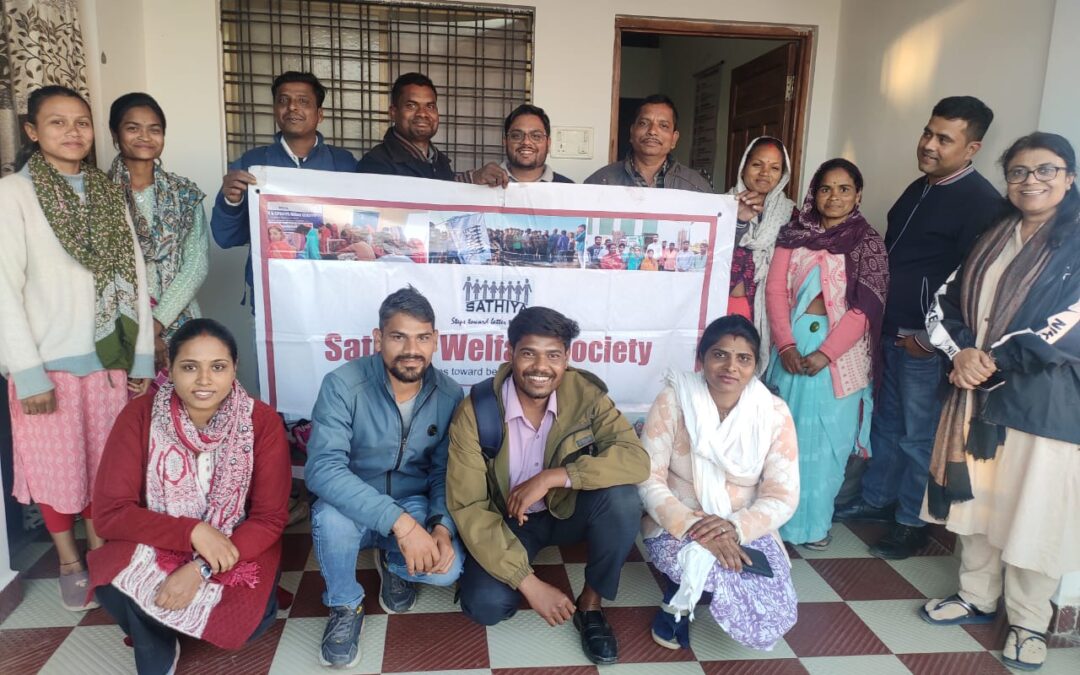
In mid-January 2026, Sathiya Welfare Society (SWS) brought its Project Leads, MIS team, Community Resource Persons and field staff together in Betul, Madhya Pradesh, for a two-day Project Inception Training — the formal launch point for a new programme to secure social security entitlements for Dalit and Adivasi households across Betul Block.
Two Days, One Shared Purpose
The training ran on 16 and 17 January 2026 in Betul, and was designed and facilitated by Mr. Tarun Bedi, Ms. Smriti (President, SWS) and Mr. Sandeep, with support from the wider team.
Its purpose was threefold:
- Orient the team to the organization and its policies, and to the ongoing programme — “Ensuring Access to Social Security Schemes for Dalit and Adivasi Households through Collectivization and Improving their Participation in Local Governance” — now reaching 29 villages across 10 Gram Panchayats of Betul Block.
- Strengthen active citizen participation at the Gram Panchayat level.
- Clearly define the roles, targets and working methods of CRPs, the Project Lead and the MIS function.
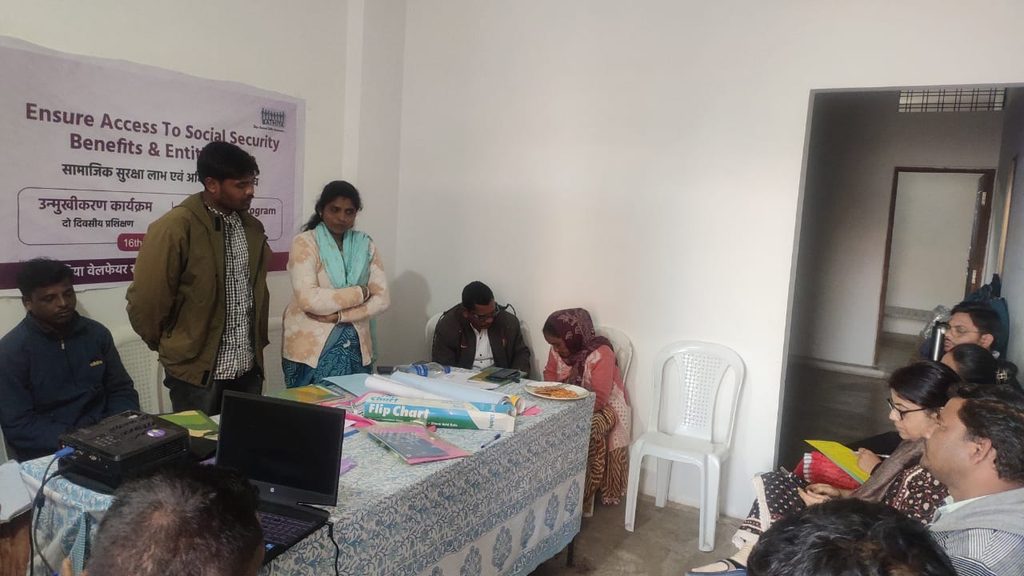
Day One: Grounding the Work in the Constitution
The first day opened with introductions, where Community Resource Persons (CRPs) shared their field experience so far — including a recurring moment from household surveys: villagers asking who they are and why the survey is happening. Mr. Bedi reframed this for the team as a positive sign, not an obstacle: a community that asks questions is an alert, engaged one. The session also cleared up a common misconception — Aadhaar enrolment for those above five years old can be completed locally in Betul, with no trip to Bhopal required — and connected Samagra ID to access to the Housing Scheme and the Ujjwala Scheme (LPG connections).
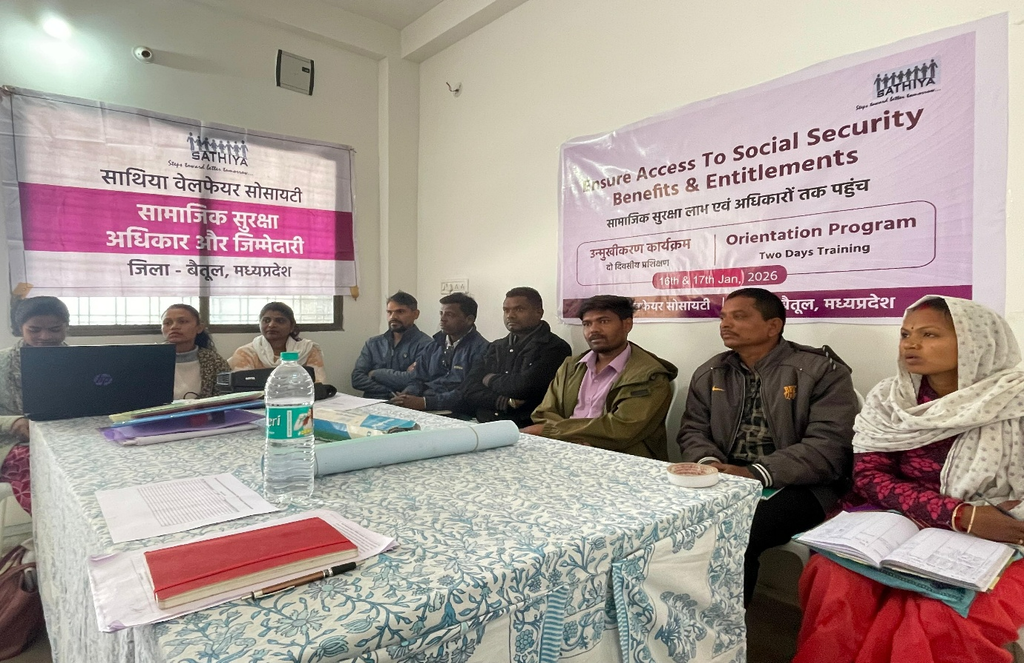
Ms. Smriti then traced SWS’s journey and its vision — to build an equitable, egalitarian and empowered society — and mission: organizing marginalized communities, particularly women and the working class, toward social, economic and political empowerment. The team was also briefed on the POSH Act, the Internal Committee’s grievance-redressal role, HR policies and the organization’s financial procedures.
In the post-lunch session, Mr. Bedi set out a disciplined target-setting framework: weekly, monthly and quarterly targets for every CRP, a common document checklist across government schemes, and a 31 March deadline for each Gram Panchayat to submit its list of eligible households.
The day closed with sessions on the Indian Constitution — the six Fundamental Rights and citizens’ corresponding duties — illustrated through model Gram Panchayats such as Hiware Bazar (Maharashtra, for water conservation) and a Rajasthan Panchayat recognized for waste management. A further session unpacked the structure of local self-governance: the 73rd Constitutional Amendment Act of 1992, the role of the Gram Sabha, the three-tier Panchayati Raj system (Gram, Janpad and Zila Panchayat), the 29 subjects assigned to Panchayats, and the Gram Panchayat Development Plan (GPDP) process.
Day Two: From Classroom to Field
Day Two opened with a recap, after which Ms. Smriti laid out the programme’s goals and the path to achieving them:
- Raise awareness and build the agency of marginalized communities across the selected Panchayats.
- Establish operational coverage in all 10 Panchayats of Betul Block.
- Connect marginalized households with government welfare schemes.
- Form a Jagruk Nagrik Manch (Aware Citizens’ Forum) in every village.
- Develop two trained leaders in each village.
- Support educational assistance through Common Service Centres (CSCs).
The expected outcomes are ambitious: Aware Citizens’ Forums formed across target villages, over 10,000 people reached with awareness of social security schemes, more than 2,200 households linked to government schemes (around 70% from marginalized groups), and 60 community leaders developed to sustain the work.
Ms. Smriti also set out detailed responsibilities for CRPs, the MIS Coordinator and the Project Lead — from maintaining a daily reporting diary and a Gram Panchayat profile and social map, to documenting success stories and coordinating with government departments.
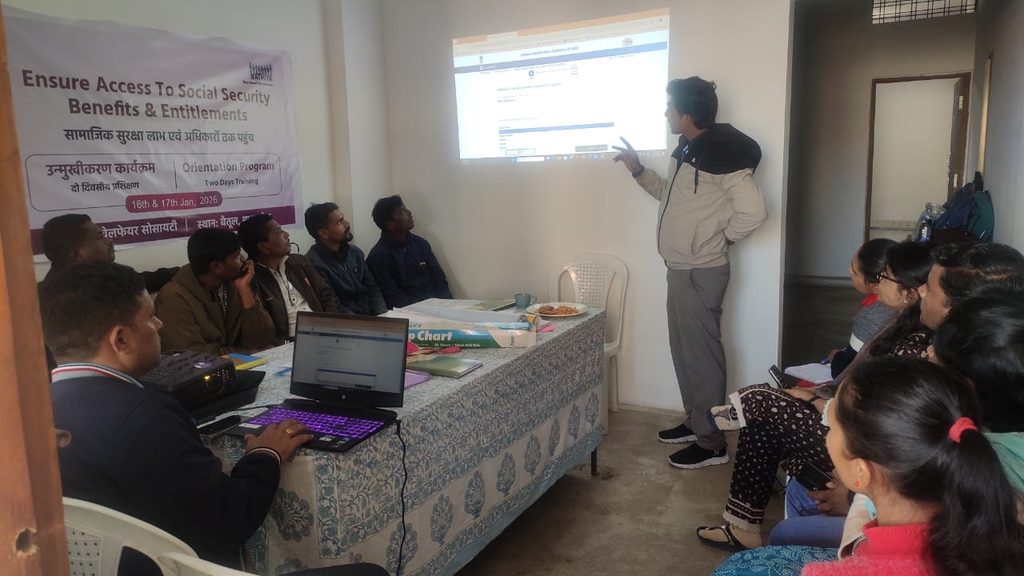
The day also included lighter, energizing moments: Mr. Jitendra led team-building activities on communication and photographic memory, while Mr. Prem Sembekar, the local Aadhaar Kendra In-Charge, briefed the team on Aadhaar enrolment and correction services available right in Betul — confirming once more that a trip to Bhopal isn’t needed, and that most address or mobile-number updates can be done independently through UIDAI’s “mAadhaar” service.
What Comes Next
The training closed with participants preparing field-level action plans. In the weeks ahead, SWS’s team will roll out CRP-wise targets, strengthen Panchayat-wise household data systems, support the formation of Aware Citizens’ Forums, develop village-level leadership, and set up a monthly review mechanism to track progress and resolve field-level bottlenecks.
Two days of structured learning have given SWS’s team the shared grounding — constitutional, institutional and practical — to carry this work into Betul Block’s villages. The real work now begins in the field, one household, one Gram Sabha and one Jagruk Nagrik Manch at a time.
Recent Comments